2026Feb, 20
Extreme ocean temperature events in South African Marine Protected Areas
South Africa’s marine realm, including its marine protected areas, are facing increasingly intense heatwaves and cold spells, threatening the biodiversity they were designed to protect. Our study reveals that SANParks-managed MPAs like Robben Island, Table Mountain, and Addo are among the hardest hit marine protected areas in South Africa. However, the ecological impacts of these extreme events remain poorly understood, highlighting the need for targeted monitoring to guide climate change adaptation strategies.
Content courtesy of SANParks. Copyright remains the property of SANParks.
Text by Nicola van Wilgen-Bredenkamp, Tammy Robinson & Kira-Lee Courtaillac
Marine heatwaves and cold-spells, short-term but intense spikes or drops in ocean temperatures, are of increasing concern to marine biologists due to their increase in frequency. South Africa’s coastline is already experiencing some of the world’s most intense thermal events. These extremes have the potential to drive ecological shifts that range from the collapse of kelp forests and mass seagrass die-offs to coral bleaching and altered food webs. While marine heatwaves have received significant attention, marine cold spells remain poorly understood, despite their potential to disrupt migratory species, fuel biological invasions, and impact commercial fisheries. Until recently, inconsistent definitions and sparse monitoring have left a gap in our understanding of these events and their impacts on biodiversity-rich marine systems.
South Africa’s coastline spans several distinct marine ecoregions, each with unique ecological characteristics. Our study took a fine-scale approach, focusing on marine thermal extremes within specific ecoregions and Marine Protected Areas (MPAs), including three SANParks managed MPAs that were large enough for inclusion (Figure 1). MPAs are designed to safeguard vulnerable marine biodiversity, but with climate change impacts intensifying, their resilience is increasingly under threat. Understanding how and where marine thermal extremes occur is vital for adapting national spatial planning and MPA management, protecting key ecosystems, and ensuring the long-term benefits these areas provide to people and nature.
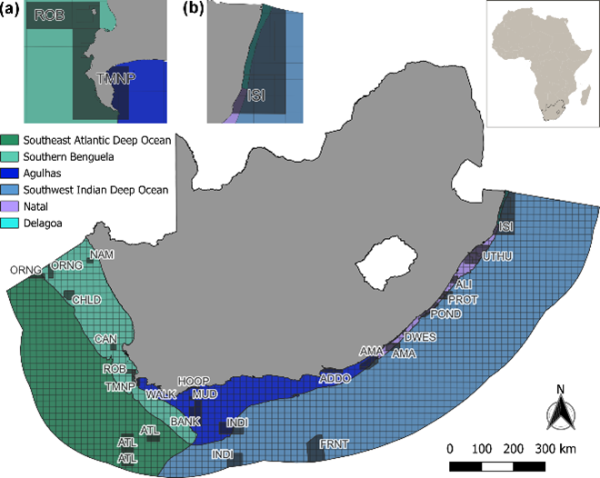
Figure 1. Location of the MPAs included in the study within the six ecoregions of the South African Exclusive Economic Zone. MPAs are abbreviated as follows and SANParks-managed MPAs included in the study appear in bold: Orange Shelf Edge (ORNG), Childs Bank (CHI), Southeast Atlantic Seamounts (ATL), Cape Canyon (CAN), Namaqua Fossil Forest (NAM), Robben Island (ROB), Table Mountain National Park (TMNP), Walker Bay (WALK), De Hoop (HOOP), Agulhas Bank Complex (BANK), Agulhas Mud (MUD), Southwest Indian Seamounts (INDI), Agulhas Front (FRNT), Addo Elephant National Park (ADDO), Amathole (AMA), Dwesa-Cwebe (DWES), Pondoland (POND), Protea Banks (PROT), Aliwal Shoal (ALI), uThukela Banks (UTHU), and iSimangaliso (ISI). Some MPAs span multiple ecoregions as illustrated in insert (a) and (b). The grid reflects quarter degree squares from which data on thermal extreme events were extracted. Because of their small size, this scale was not relevant to smaller MPAs.
We analysed 40 years of satellite-derived sea surface temperature data (1982–2022, from the Advanced Very High Resolution Radiometer) to identify marine heatwaves and cold-spells, defined using standard thresholds to delineate temperature extremes lasting five or more days. By calculating the frequency, intensity, and duration of these events, and combining them into a single severity index, we were able to rank and compare impacts across protected areas.
The three SANParks managed MPAs included in the study ranked among the most impacted MPAs for both types of thermal extremes (hot and cold spells). Robben Island and the Table Mountain National Park (TMNP) MPAs, both located within the Southern Benguela ecoregion, stand out for experiencing some of the most intense marine heatwaves (MHWs) and marine cold-spells (MCSs) in the country. These MPAs recorded the highest maximum mean intensity for MHWs, peaking as high as 4.19°C above the critical limit used to identify a heatwave in this region. TMNP also experienced the most severe single MHW event recorded across all MPAs, with cumulative heat exposure exceeding 200 °C·days (this metric reflects that the event lasted 58 days at an average of 3.5oC above the region’s hottest temperatures [90th percentile]). For MCSs, Robben Island and TMNP experienced the longest events, each lasting over 100 days, and showed worsening trends in cumulative cold intensity over time (Table 1). Notably, the most intense heatwaves along the South African coast occurred in Addo, but this was also the only MPA with a declining trend in both the number and intensity of heatwaves, while also recording some of the most intense cold-spells in the country (–2.67 °C average), signalling complex local dynamics.
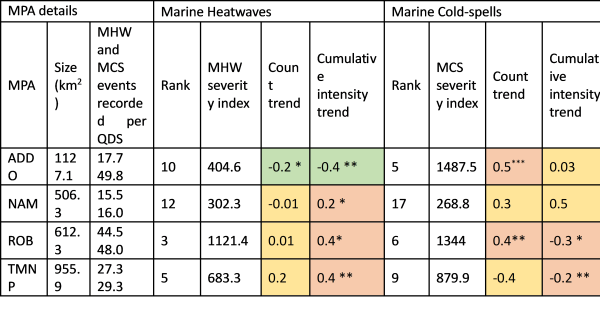
Table 1. Severity of MHWs and MCSs within SANParks-managed MPAs, including Namaqua Fossil Forest due to its proximity to the Namaqua MPA, showing trends in the annual number of extreme events as well as cumulative intensity of events reflected by linear model coefficients. Significant trends appear in bold (e * P<0.05; **P<0.01; ***P<0.001 ) and red is used to signify increasing severity, green decreasing severity and orange indicates no change through time. Note that an increase in cumulative intensity of MHW is indicative of increasing severity, while a decline in cumulative intensity of MCS is indicative of increasing severity. MPAs are ranked based on their severity indices (ranks out of the 21 MPAs considered).
These extreme thermal events have major ecological implications for biodiversity and ecosystem resilience. Robben Island MPA, delineated in part to protect the foraging grounds of endangered African penguins, aims to improve food availability through fishery exclusions. However, shifting prey distributions, influenced by multiple factors, but also linked to changing ocean temperatures, threaten these gains. Nearby, TMNP’s position at the junction of two marine ecoregions means it spans distinct ecological zones experiencing different thermal stressors. The western side faces more severe thermal extremes and may be at heightened risk from invasive species outbreaks, such as the recent arrival of Membranipora membranacea, a bryozoan that can damage kelp forests under warming conditions. In contrast, the eastern side in False Bay has shown sensitivity to extreme cold events, such as in 2022 where a 48-day cold-spell coincided with the mass stranding of over 100 evil eye pufferfish (Amblyrhynchotes honckenii), highlighting the differing vulnerabilities across this single MPA. Changes experienced across MPAs suggest potential shifts in oceanographic regimes and underscore the need for localised, ecosystem-specific monitoring to inform strategies to maintain the ecological integrity of SANParks’ MPAs under climate change. It is possible that a more connected and flexible approach to the delineation of no-take zones and MPAs may be required in future.
Reference: Courtaillac, K.L., vanWilgen, N.J.& Robinson, T.B. (2026) Identifying South African marine protected areas at risk from marine heatwaves and cold-spells. Scientific Reports 16:2814.
https://www.nature.com/articles/s41598-025-32725-0